AI Video Booth vs. Traditional Video Booth: What's Actually Different
Introduction
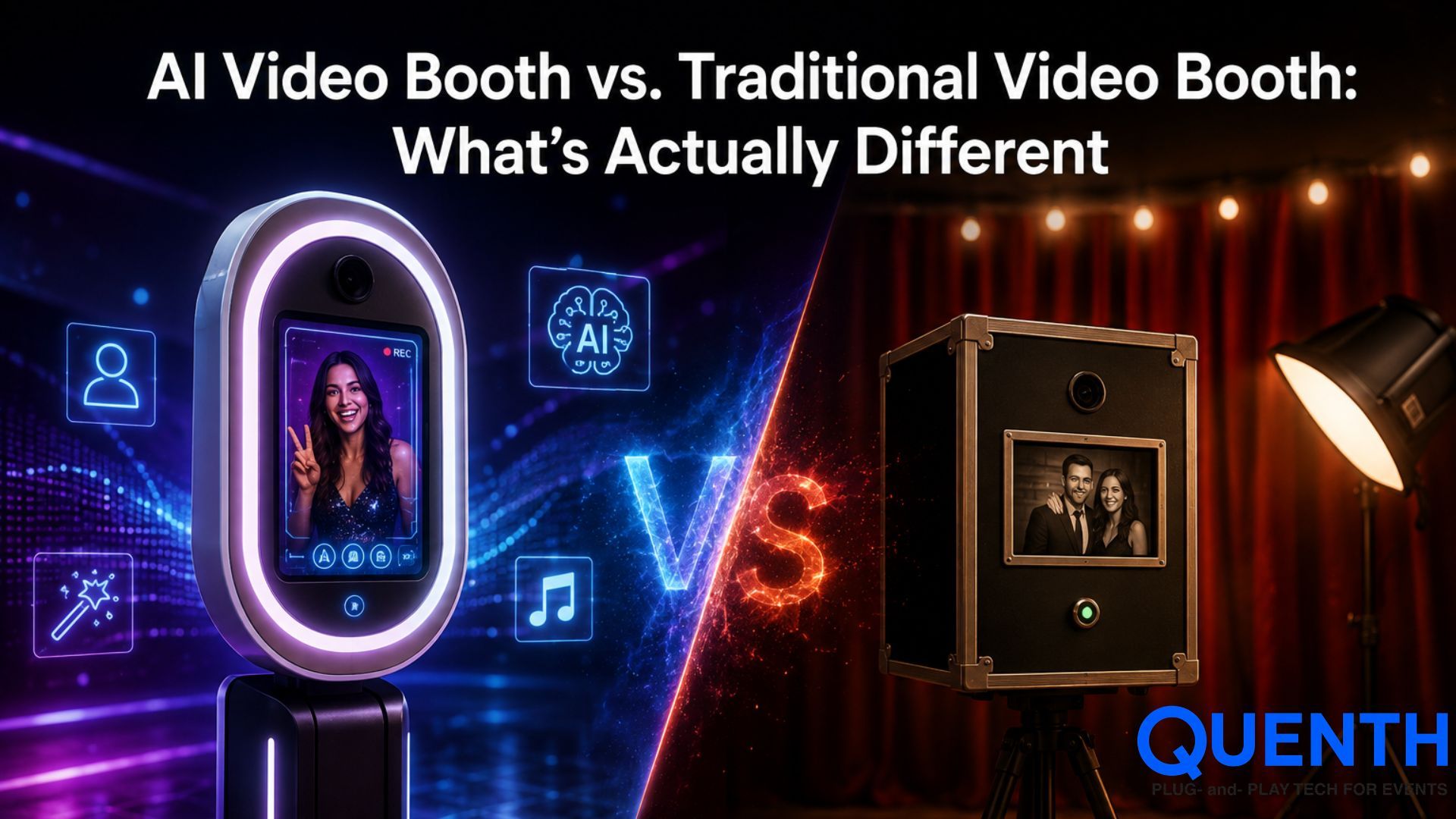
AI Video Booths are clearly the latest glamorous entry in event town, the buzz everyone wants a share of. But where does the hype end and real value begin? And are traditional video booths just biding their time until they’re fast rendered obsolete?
Both put a guest in front of a camera. Both end with a shareable video. But past that, they're solving genuinely different problems — and picking the wrong one for your event means either overspending on a transformation nobody needed, or underdelivering on the "wow" moment your event actually called for.
Here's the real difference, not just the marketing version.
Why the traditional video booth remains an evergreen choice
A traditional or classic video booth captures a short video of the guest exactly as they are, with a branded overlay on top that contains your event name, brand logo, and a themed frame around the captured footage. No transformation, no AI processing. What the camera sees is what the guest gets, just packaged cleanly. Pretty straightforward in doing its job.
Here is what it's good at:
- ✓ Fast turnaround — no generation and AI processing time; the video is ready the moment recording stops.
- ✓ Predictable output — what you see during recording is exactly what gets delivered to the guest- with a custom template attached.
- ✓ Lower complexity — fewer moving parts, fewer things that can go visually "wrong."
- ✓ Strong fit for — testimonial-style content, brand messages, or guest shoutouts where authenticity matters more than spectacle.
Where it falls short:
- ! No transformation means no real surprise. The booth misses the excitement of a touch of novelty. Guests know roughly what they're getting before they even step up to the booth.
- ! The video booth output contains no such element that would make it genuinely shareable on its own, without strong creative direction on the overlay/branding side or a rigorous hashtag campaign.
What makes AI video booth the rising star on the horizon
An AI video booth takes that same guest moment of a few seconds in front of the camera, a simple picture, and transforms it for unlimited creative potential to explore. The guests are gifted with exciting, one-of-their-kind creations where they've become something else entirely. Turned into their favourite superhero. Sent flying across the world’s hottest travel destinations or through a different one. Recreating that iconic movie scene that doesn’t leave their head. This isn't a filter layered on top of the original footage — it's a generated video built around the guest's likeness.
What it's good at:
- ✓ The actual "wow" moment — guests are far more likely to immediately share something they didn't expect, a fun visual that is not ordinarily encountered.
- ✓ Naturally viral-shaped content — transformation videos travel further on social media than a straight branded clip, all the more because their themes create pop-culture-relatable moments.
- ✓ Perfect for — brand activations that want to be truly memorable, not just documented.
Where it takes more thought:
- ! Video generation takes real processing time, so booth-line pacing needs to be planned for, especially for high-footfall events.
- ! The transformation needs to actually fit the event's tone — a superhero transformation at a solemn or formal occasion can misfire badly.
So which one should your event actually use?
| Feature / Metric | Traditional Video Booth | AI Video Booth |
|---|---|---|
| Best for | Testimonials, brand messages, authentic guest content | Brand activations, product launches, high-energy events |
| Turnaround | Instant | Short generation time |
| Predictability | Guest sees exactly what they'll get | Transformation is part of the surprise |
| Shareability | Depends on creative direction | High, by default |
| Tone fit | Formal, professional, testimonial-driven events | Fun, high-energy, spectacle-driven events |
Neither one is the "better" booth. That’s not the case we’re making. They're built for different jobs. A leadership offsite collecting genuine reflections from executives almost certainly wants the traditional booth, sans the pomp and show. A consumer brand launch trying to get guests posting on their own social feeds or a campaign seeking virality almost certainly wants the AI-powered option.
Some events genuinely benefit from running both, side by side, and letting guests choose — which is easier when they're two configurations of the same underlying platform- Quenth, not two separate vendors to be juggled.
Both connect to the same rest of the platform
Whichever video booth you choose, the output doesn't have to stop at "guest gets a video." Like everything covered in our complete guide to event photo and video booths, a video output from either of these booths can:
- ✓ Display live on a screen as it's captured
- ✓ Feed into a wall alongside photo submissions
- ✓ Carry a Dynamic Overlay with the guest's name or event details
- ✓ Sit behind Lead Capture, turning every video into a qualified lead
Not sure which fits your event? Book a demo and we'll show you both running live, side by side.
FAQs about Event Booths
Does an AI video booth take longer per guest than a traditional one?
Yes, a traditional video is instant since there's no transformation step, while AI video requires generation time. For high-traffic events, this affects how you plan booth-line pacing.
Can I run both a traditional and an AI video booth at the same event?
Yes. Since both run on the same underlying Booths engine, running both as separate stations is straightforward rather than needing two different vendor setups.
Which one gets shared more on social media?
AI video transformations tend to get shared more by default, since the transformation itself is inherently more novel and surprising than a branded clip of the guest as they normally look.
Is AI video booth output usable for professional or corporate content?
It can be, depending on the transformation style chosen — a subtle, brand-aligned transformation works fine for corporate use, while a dramatic one (like a superhero transformation) may be better suited to consumer or high-energy activations.
Related Articles




Your next event deserves better than the last one.
Twenty minutes. We'll show you what your event could look like if every photo carried a name, every display carried a face, and every output left attendees feeling seen.